

You may have been hearing the term “Super flu” more often lately.
Is it really that serious?
Recently, news reports and social media posts have frequently mentioned phrases such as “Super flu is spreading” or “This year’s influenza is more severe than usual.”
Since December 25, 2025, cases of what is being referred to as Super flu, identified as Influenza A (H3N2) subclade K, have been confirmed in Indonesia. According to an official announcement from the Indonesian Ministry of Health (Kemenkes), 62 cases have already been detected nationwide.
Many people are asking:
- How is this different from regular influenza?
- Does the flu vaccine still work?
- Are children and older adults at higher risk?
In this article, Dr. Matilda from our clinic explains Super flu in a clear and easy-to-understand way.
Is “Super Flu” an Official Medical Diagnosis?
The short answer is no.
Super flu is not an official medical term.
It is a colloquial expression used when a particularly severe influenza outbreak occurs, typically characterized by:
- High transmissibility
- More severe symptoms in many patients
- Longer recovery periods than usual
From a medical standpoint, this situation is best described as an outbreak caused by a mutated influenza virus.
In Indonesia, the 2025 influenza season began earlier than usual, with a higher number of cases compared to previous years. During the second half of 2025 (July–November), the influenza positivity rate rose to approximately 30–40%.
Since December, we have observed a slight decline in positivity rates at our clinic, which is also reflected in national statistics. However, please note that data from the most recent month—especially December—may be updated later due to reporting delays. Therefore, these figures should be interpreted as overall trends rather than exact values.
Infections with H3N2 subclade K have been confirmed in multiple regions, including West Java, East Java, and South Kalimantan. Importantly, the Ministry of Health has stated that there has been no significant increase in hospitalizations or severe cases, and no evidence of a sudden rise in mortality at this time.
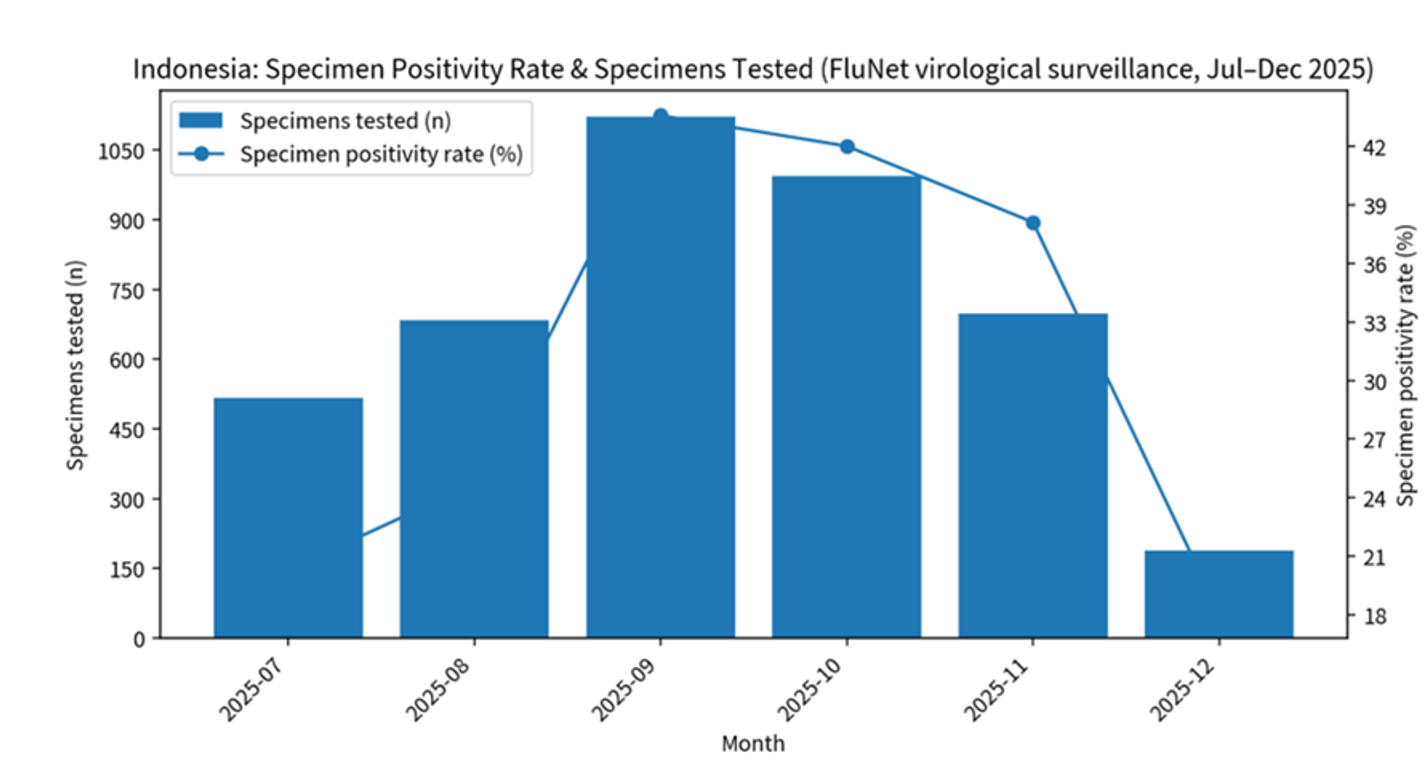
Figure 1. Indonesia: Monthly Influenza Positivity Rate (%) and Number of Samples (July–December 2025)
Note: Data compiled by our clinic based on publicly available WHO FluNet (GISRS) data.
Positivity rate = INF_ALL / SPEC_PROCESSED_NB × 100
Bars represent the number of samples tested; the line indicates the positivity rate.
Recent months, particularly December, may be subject to reporting delays and should be interpreted as trends.
Globally, many countries and regions have also reported that influenza activity in 2025 began earlier than usual and has been more intense. These reports suggest that influenza activity has been increasing across the Northern Hemisphere toward the end of 2025.
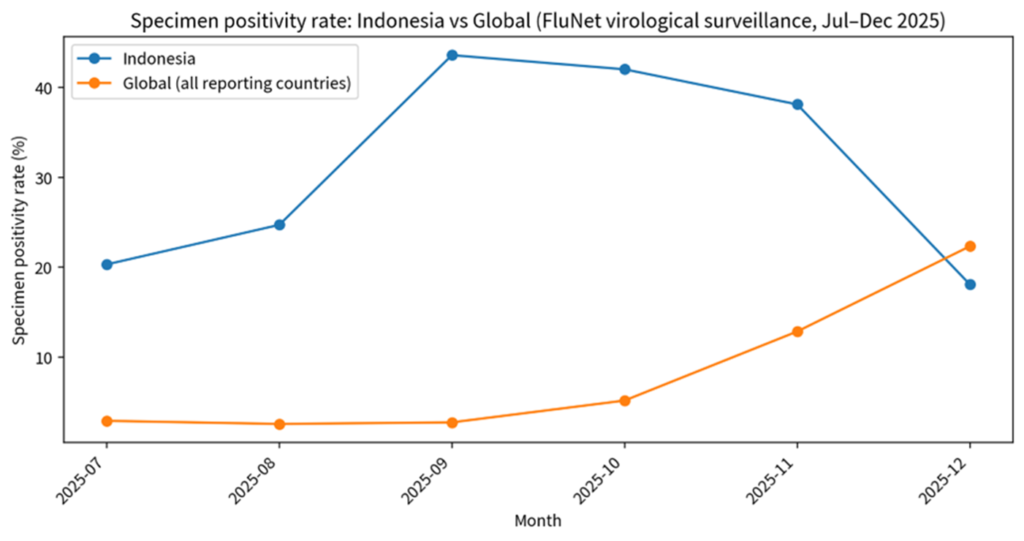
Figure 2. Influenza Positivity Rate (%)
Indonesia vs. Global Data (July–December 2025)
Note: Aggregated data reported to WHO FluNet (GISRS).
Because testing systems and target populations differ by country, international comparisons should be interpreted as an indicator of overall trends, not direct comparisons of severity.
Why Does This Year’s Flu Feel So Severe?
Influenza viruses change slightly every year.
In particular, Influenza A strains (such as H3N2) mutate easily, which means that immunity from past infections or vaccinations may be less effective.
Reasons why symptoms may feel more severe this season include:
- Circulation of strains that evade existing immunity
- Higher likelihood of high fever and profound fatigue
- Prolonged cough and systemic symptoms
As a result, many patients report that:
“The exhaustion is much worse than usual”
“It takes longer to recover”
How Is This Different From Regular Influenza?
| Feature | Typical Influenza | “Super Flu” Cases |
| Fever | 38–39°C (100–102°F) | Persistent fever ≥39°C (102°F) |
| Fatigue | A few days | May last more than a week |
| Respiratory symptoms | Mild cough | Prolonged cough, shortness of breath, chest pain |
| Complications | Mild pneumonia | Severe pneumonia, ARDS |
| Recovery time | 5–7 days | 10 days or longer |
※Extra caution is needed for older adults, children, pregnant women, and people with chronic medical conditions.
Is the Flu Vaccine Still Effective?
Yes—absolutely.
The flu vaccine is not only meant to prevent infection entirely.
The true benefits of vaccination:
- Reduces the risk of severe illness
- Lowers the likelihood of hospitalization and pneumonia
- Helps shorten recovery time
Studies consistently show that vaccinated individuals tend to experience milder symptoms.
While the influenza vaccine may not completely prevent infection, it has been clearly proven to significantly reduce the risk of severe disease, hospitalization, and death.
What Should You Do If You Think You’re Infected?
Seek medical care early
Antiviral medications are most effective when started within 48 hours of symptom onset.
Seek prompt medical attention if you experience:
- Persistent fever ≥39°C (102°F)
- Shortness of breath or chest pain
- Severe fatigue that prevents normal activity
- Inability to eat or drink adequately
What You Can Do at Home to Prevent Infection
There are many simple steps you can start today:
- Wash your hands regularly and wear a mask when appropriate
- Rest and avoid pushing yourself when you feel unwell
- Maintain adequate sleep and balanced nutrition
- Consult a healthcare provider early if you develop a fever
Summary | Stay Informed and Take Calm, Preventive Action
- Super flu is not an official medical diagnosis
- It refers to an influenza outbreak that feels more severe than usual
- Vaccination and early medical care are the most effective protections
If you experience concerning symptoms, do not hesitate to seek medical advice.
Although Super flu is not a formal medical term, it is true that influenza with more intense symptoms has been circulating since late December. Accurate information and early action are the best ways to protect yourself and your family.
At our clinic, we are committed to providing personalized care and clear explanations tailored to each patient’s situation.
If you have any concerns, please feel free to consult us at any time.
\ 最新情報をチェック /
